
This content is associated with The Open University's History courses and qualifications and Early Years courses and qualifications.
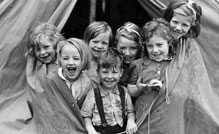
When I look back on my own childhood in the 1970s and 80s and compare it with children today, it reminds me of that famous sentence ‘The past is a foreign country: they do things differently there’ (from L. P. Hartley’s novel The Go-Between).
Even in a relatively short period of time, I can see the enormous transformations that have taken place in children’s lives and in the ways they are thought about and treated.
Looking further back I can see vast differences between contemporary and historical childhoods. Today, children have few responsibilities, their lives are characterised by play not work, school not paid labour, family rather than public life and consumption instead of production.
Yet this is all relatively recent. A hundred years ago, a twelve-year-old working in a factory would have been perfectly acceptable. Now, it would cause social services' intervention and the prosecution of both parents and factory owner.
American colonial families: Industrious girls treated with respect
The differences between the expectations placed on children today and those placed on them in the past are neatly summed up by two American writers, Barbara Ehrenreich and Deirdre English. Comparing childhoods in America today with those of the American Colonial period (1600-1775), they have written:
‘Today, a four year-old who can tie his or her shoes is impressive. In colonial times, four-year-old girls knitted stockings and mittens and could produce intricate embroidery: at age six they spun wool. A good, industrious little girl was called 'Mrs.' instead of 'Miss' in appreciation of her contribution to the family economy: she was not, strictly speaking, a child’.
Childhood: A social construction?
These changing ideas about children have led many social scientists to claim that childhood is a ‘social construction’. They use this term to mean that understandings of childhood are not the same everywhere and that while all societies acknowledge that children are different from adults, how they are different and what expectations are placed on them, change according to the society in which they live.
Social anthropologists have shown this in their studies of peoples with very different understandings of the world to Western ones.
Canadian Arctic: Acquiring understanding
Jean Briggs has worked with the Inuit of the Canadian Arctic and has described how, within these communities, growing up is largely seen as a process of acquiring thought, reason and understanding (known in Inuit as ihuma).
Young children don’t possess these qualities and are easily angered, cry frequently and are incapable of understanding the external difficulties facing the community, such as shortages of food.
Because they can’t be reasoned with, and don’t understand, parents treat them with a great deal of tolerance and leniency. It’s only when they are older and begin to acquire thought that parents attempt to teach them or discipline them.
Tonga: Closer to insanity than adulthood
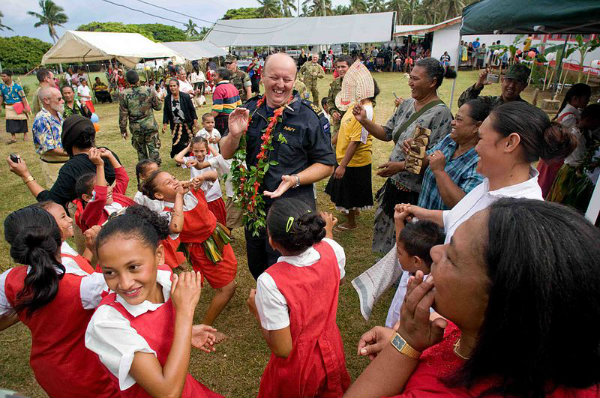 Royal New Zealand Navy Petty Officer Richard Boyd dances with school children during a Pacific Partnership 2009 community service project at Faleloa Primary School, Tonga. But some chilldren have a tougher time of it on the island. [Image: US Navy].
In contrast, children on the Pacific island of Tonga, studied by Helen Morton, are regularly beaten by their parents and older siblings.
They are seen as being closer to 'mad' people than adults because they lack the highly prized quality of social competence (or poto as the Tongans call it).
They are regularly told off for being clumsy and a child who falls over may be laughed at, shouted at, or beaten. Children are thought of as mischievous; they cry or want to feed simply because they are naughty, and beatings are at their most severe between the ages of three and five when children are seen as particularly wilful.
Parents believe that social competence can only be achieved through discipline and physical punishment, and treat their children in ways that have seemed very harsh to outsiders.
The Beng: Arrivals from a spirit world
In other cases, ideas about children are radically different. For example, the Beng, a small ethnic group in West Africa, assume that very young children know and understand everything that is said to them, in whatever language they are addressed.
The Beng, who’ve been extensively studied by another anthropologist, Alma Gottleib, believe in a spirit world where children live before they are born and where they know all human languages and understand all cultures.
Life in the spirit world is very pleasant and the children have many friends there and are often very reluctant to leave it for an earthly family (a fictional account of a spirit child’s journey between the spirit and the earthly world is given in Ben Okri’s novel, The Famished Road).
When they are born, they remain in contact with this other world for several years, and may decide to return there if they are not properly looked after. So parents treat young children with great care so that they’re not tempted to return, and also with some reverence, because they’re in contact with the spirit world in a way that adults aren’t.
The UK: Dependency
There’s a tendency to view children in the UK, and in the Western world in general, as incompetent and dependent. But this isn’t the case throughout the world. In many societies children work and contribute to the family in whatever way that can from a very early age.
A good example of this is child care. In the UK, it is illegal for a child under the age of fourteen to look after another child unsupervised, because they’re deemed incompetent and irresponsible.
The Fulani: Working by the age of four
In other cultures, this is not the case. Michelle Johnson has written about the Fulani of West Africa describing how by the age of four, girls are expected to be able to care for their younger siblings, fetch water and firewood and by the age of six will be pounding grain, producing milk and butter and selling these alongside their mothers in the market.
The Yanamamo: Girls marry earlier than boys
![Yanomami children [Image by Ambar under CC-BY-SA licence]](https://www.open.edu/openlearn/pluginfile.php/3261151/tool_ocwmanage/articletext/0/Yanomami_catland.jpg) Yanomami children [Image by Ambar under CC-BY-SA licence].
Yanomami children [Image by Ambar under CC-BY-SA licence].

Across the world, among the Yanamamö of the Amazonian rainforest, another anthropologist, Napoleon Chagnon, has shown how different these children’s childhoods are from Western ones, and also how differently boys and girls grow up in comparison with other parts of the world.
He has written how a Yanamamö girl is expected to help her mother from a young age and by the age of ten will be running a house. By the age of twelve or thirteen she is probably married and will have started to have babies.
Boys on the other hand, have far fewer responsibilities. They don’t marry until later than girls and are allowed to play well into their teens. Western notions of childhood simply do not ‘fit’ in these cases, where children’s competence and responsibilities are understood very differently.
Studying very different communities
Social anthropologists ask questions about how childhood, and the role of children, is seen within the communities they study, rather than how it fits into Western ideas about childhood.
By doing this they seek to avoid imposing outside ideas onto people with very different understandings of the world or of making value judgments on other people’s ways of raising their children.
While Westerners might take exception to eight-year-old girls working or to twelve-year-old girls marrying, within their own communities such activities are seen as a normal and positive part of childhood. Indeed, seen through the eyes of non-Westerners, many ‘normal’ Western childcare practices are seen as extremely bizarre and possibly harmful to children.
Placing children in rooms of their own, refusing to feed them on demand, or letting them cry rather than immediately tending to them, are viewed very negatively in many societies and lead some to think that Westerners don’t know how to look after children properly.
A changing phenomenon
Childhood is a changing social phenomenon, of continual fascination and concern. Looking at it from a cross-cultural perspective shows the wide variety of childhoods that exist across the world and warns against interfering in or criticising people whose lives, and understandings of the world, are very different to our own.
All societies recognise that children are different to adults and have particular qualities and needs; what anthropologists and other social scientists are interested in are the ideas that each society has about the nature of childhood and the impact these views have on children’s lives.
Editor's Note: This page was originally published with an photograph of The Shilluk people in their village Yom - in Tonga, Sudan, rather than the Pacific Island of the same name to which the article referred.
Study a free course on childhood
-

Supporting children and young people's wellbeing
Learn more to access more details of Supporting children and young people's wellbeingThis free course, Supporting children and young people's wellbeing, looks at some of the broader concerns regarding wellbeing and the idea that children and young people today are increasingly reporting feelings of unhappiness. By completing the activities, you will be introduced to different ways of understanding children and young people’s ...
-
Introduction to child psychology
Learn more to access more details of Introduction to child psychologyChildhood is a time of rapid growth and development, and studying these changes is endlessly stimulating. In this free course, Introduction to child psychology, you will be introduced to the discipline of child psychology and some of the key questions that guide the understanding of childhood. These questions include 'What influences children's...
-
Children’s perspectives on play
Learn more to access more details of Children’s perspectives on playIn this free course, Children's perspectives on play, you are asked to put yourself in the place of young children and to think about their view of play and their reasons for playing. When children have personal freedom to choose and make decisions about what and who they want to play with, as well as where they want to play, they are highly ...
Read another article on childhood
-

Why we should abolish imprisonment for children and young people
Watch now to access more details of Why we should abolish imprisonment for children and young peopleDr David Scott takes a look at the consequences of imprisoning children and young people, and the alternative solutions to this.
-

Why mothers post about their children on social media
Read now to access more details of Why mothers post about their children on social mediaAre social media posts expressions of love and care in the digital age?
-
Young children and the climate crisis
Read now to access more details of Young children and the climate crisisTackling ecological and social injustice together: how early years practitioners and young children can respond to the climate crisis alongside non-human creatures and the material world around them.
Rate and Review
Rate this article
Review this article
Log into OpenLearn to leave reviews and join in the conversation.
Article reviews